This July is a milestone month for Natco Logistics: we’re celebrating 30 years in the freight forwarding industry, and marking the occasion the same way we’ve built the business – by staying close to our clients and focused on the shipment in front of us.
That focus matters this month more than most. Ocean freight rates are climbing, capacity is tightening across sea and air, winter weather is disrupting South African ports, and a run of customs changes have taken effect from 1 July.
Thirty years in, our approach to all of it hasn’t changed: clear communication, accurate documentation and realistic planning. Here’s what the milestone means to us, and what July means for your cargo.
This year marks a proud milestone for Natco Logistics as we celebrate 30 years of service, growth and commitment to the freight forwarding industry.
Established in Johannesburg in 1996, Natco has grown from its early roots in specialised logistics projects into a trusted logistics partner offering end-to-end freight forwarding, customs, warehousing, and distribution solutions across South Africa and beyond.
At the heart of this journey has always been people. Natco’s strength lies not only in moving cargo, but in the relationships we build, the trust we protect and the accountability we bring to every shipment. In an industry where delays, disruptions and uncertainty are part of daily reality, our clients continue to rely on Natco for practical solutions, clear communication, and hands-on service.
Under the leadership of our CEO, Patrick Dürig, Natco continues to reflect the values that have shaped the business for three decades: professionalism, partnership, integrity and long-term commitment. Patrick’s leadership has helped carry forward a culture where service is personal, solutions are tailored and every client relationship matters.
A company does not reach 30 years by standing still. It reaches 30 years by adapting, improving, and staying close to its clients, its people and the market it serves. From Johannesburg to Durban, Cape Town and Port Elizabeth, Natco’s national footprint continues to support importers, exporters and project cargo clients with confidence and care.
As we celebrate this milestone, we also honour our management team, our staff members, our clients, our international partners and our service providers who have all formed an integral part of the Natco story.
Your trust, loyalty and dedication have helped build the company we are very proud of today.



July is expected to bring higher freight costs, tight capacity and continued pressure on delivery times. Early booking, accurate customs documents and realistic lead times will be important.
Ocean Freight Rates Are Climbing
Global container rates rose sharply during June. The Drewry World Container Index increased by 12%. Rates between Asia and Europe also moved higher.
This may affect South African trade lanes as carriers introduce July rate increases, peak season charges and revised fuel surcharges. Surcharges range between USD 250–550 per TEU.
What this means for clients:
- Rates may change quickly.
- Quotations may have shorter validity.
- Space may be limited on popular sailings.
- Early booking is strongly recommended.
Vessel Delays Remain a Concern
Global vessel reliability improved during April, but late vessels still arrived more than five days behind schedule on average.
Port congestion, weather, equipment shortages and missed connections can still disrupt delivery dates. Clients should allow extra time for transshipment, customs clearance and inland delivery.
South African Ports Face Winter Delays
Winter weather may affect operations at Durban, Cape Town and Port Elizabeth. Cape Town remains especially vulnerable to strong winds, while Durban may experience delays linked to weather, vessel congestion and crane availability.
Importers and exporters should monitor stack dates, vessel cut-offs and terminal updates closely. Delivery should not be arranged only according to the estimated vessel arrival date.
Congestion Continues in Europe and Asia
Several European ports continue to experience high yard levels, reduced equipment availability and rail delays. Rotterdam, Hamburg and Bremerhaven remain under pressure.
In Asia, weather and congestion have affected ports including Shanghai, Qingdao, Singapore and Tanjung Pelepas. Cargo may be delayed before it even reaches the export vessel, which can result in missed sailings and additional storage costs.
African Port Delays Remain High
Several African ports are reporting extended waiting times. Tema, Conakry, Abidjan, Mombasa and Dar es Salaam are among the ports experiencing operational pressure.
This may affect regional shipments, feeder connections, reefer cargo and project freight. Businesses trading across Africa should allow additional time and confirm routing options before booking.


African Airfreight Capacity Remains Tight
Global air cargo demand increased during April, while available capacity remained limited. African airline cargo demand increased by 7.7%, while capacity decreased by 9.4%.
This means demand is growing faster than available space. South African shippers may face higher rates, indirect routing and limited space for urgent cargo.



New SARS Invoice Requirements
New SARS customs invoice and worksheet requirements take effect from 3 July 2026. Commercial invoices must contain clear and complete product information.
This includes accurate descriptions, quantities, values, country of origin, tariff headings and all relevant freight charges. Poor descriptions or missing information may lead to customs queries and clearance delays.
Electronic Declarations for Foreign Vehicles
New electronic declaration requirements for foreign-registered vehicles take effect from 1 July 2026. This is important for cross-border transporters and companies temporarily moving vehicles into or out of South Africa. The declaration should be completed before the vehicle reaches the border.
New Duties on Selected Imported Products
Recent SARS tariff changes affect certain PET products, steel products and aluminium profiles. Importers should confirm the tariff heading, country of origin and applicable duty before shipping. Incorrect tariff calculations can have a major impact on landed cost.
South African Exports to China
Certain qualifying South African goods may receive zero tariff treatment when exported to China. Exporters must still confirm the tariff heading, origin rules and required supporting documents. Zero duty should not be assumed without written confirmation.
New EU Duty on Low Value Parcels
From 1 July 2026, the European Union will introduce a temporary customs duty of €3 per product category on certain parcels valued below €150. This may affect South African online sellers shipping directly to customers in Europe. Businesses should review pricing, tariff codes and delivery terms before shipping.
Digital ATA Carnets Introduced
The European Union, United Kingdom, Norway and Switzerland started introducing digital ATA Carnets from 1 June 2026. These are used for temporary exports such as exhibition goods, samples and professional equipment. Companies should confirm whether digital and paper documents are required during the transition period.



Winter Weather Raises the Stakes on Cargo Cover
With Cape Town and Durban both facing winter-related disruption this month, it’s a good time to check that cargo cover reflects reality on the ground. Policies written around normal transit times may not adequately cover the extended dwell times, transshipment delays and inland delivery pressure this winter is causing.
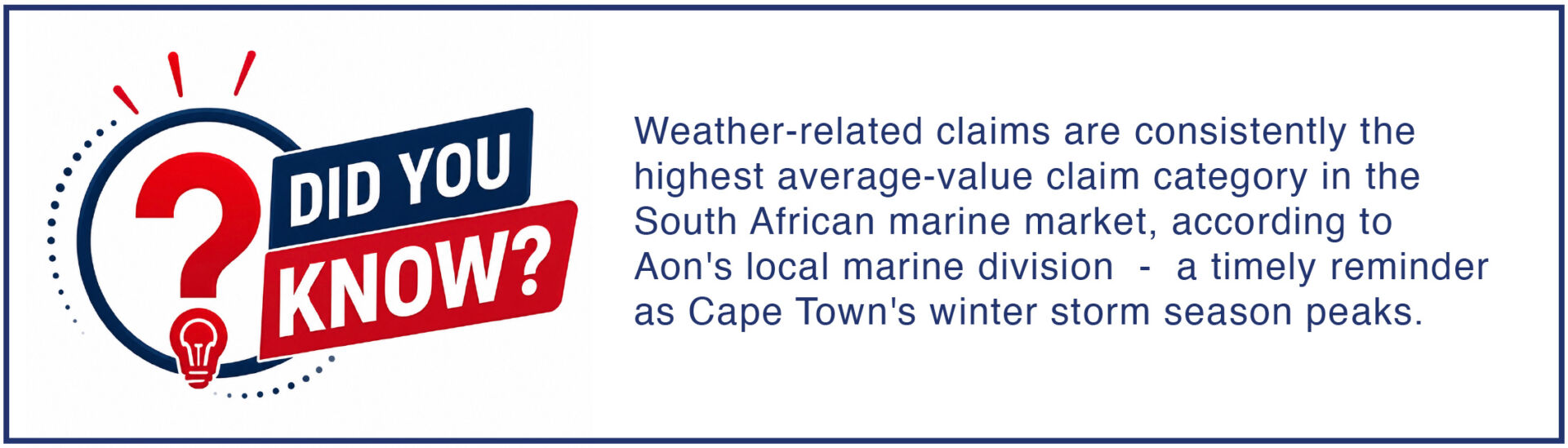
Aon’s local marine division has previously identified weather-related claims as the highest average-value claim category in the South African market – a trend directly relevant as Cape Town’s storm season peaks and Durban contends with congestion and crane availability.
Rising Freight Values Need Rising Cover
As ocean freight rates and surcharges climb through July, declared cargo values that were accurate a few months ago may now understate a shipment’s true worth. Under-insurance is one of the most common – and most avoidable – reasons a claim settles for less than expected.
- Cargo Crime Remains an Ongoing Risk
- Truck hijacking and cargo theft remain an active risk on South African freight corridors.
- Standard cargo policies that cover only the value of goods may leave exposure on recovery costs, business interruption and delay-related losses – worth reviewing alongside this month’s routing and scheduling disruptions.